When a piece of ceramic jewelry slips from your hand or falls from a height of one meter, the consequences are far from predictable. Unlike metals or plastics, ceramic materials possess unique physical properties that make their behavior under impact both fascinating and complex. To understand what happens during such an event, we must delve into the nature of ceramics, the design of the jewelry, and the conditions of the fall itself.
Ceramics, by their very composition, are hard and resistant to compression but notoriously brittle when subjected to tensile stress or sudden impacts. This brittleness stems from their atomic structure—a rigid lattice of ionic or covalent bonds that leaves little room for deformation. When force is applied rapidly, as in a fall, the material cannot dissipate the energy through plastic deformation like metals would. Instead, the energy concentrates at microscopic flaws or imperfections in the ceramic, leading to crack propagation and, often, fracture.
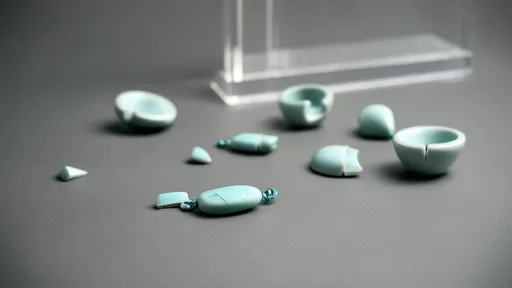
The outcome of a one-meter drop test depends heavily on the type of ceramic used. Advanced ceramics, such as zirconia or alumina, are engineered for higher toughness and may survive minor impacts unscathed. These materials are often used in high-end watches or durable jewelry lines precisely because of their improved resistance to shock. On the other hand, traditional ceramics or porcelain, common in artisanal pieces, are far more vulnerable. A one-meter fall onto a hard surface could result in visible cracks, chipping, or even shattering, especially if the piece has thin or intricate sections.
Design plays a critical role in determining whether a ceramic jewelry piece withstands a fall. Factors such as thickness, shape, and structural support all influence durability. A thick, solid ceramic pendant might emerge with only a minor chip, while a delicate, hollow-designed ring could fracture catastrophically. Additionally, elements like glazing or coatings can sometimes provide a slight buffer against impact, though they are rarely sufficient to prevent damage entirely. Jewelry that incorporates metal settings or composite materials may fare better, as these components can absorb some of the impact energy that would otherwise be transferred directly to the ceramic.
The surface onto which the jewelry falls is another crucial variable. Dropping a ceramic piece onto a soft surface, such as carpet or grass, might result in no damage at all, as the yielding material absorbs much of the kinetic energy. However, a hard surface like tile, concrete, or hardwood flooring presents a worst-case scenario. The rigidity of these surfaces means that the energy from the fall is reflected back into the jewelry almost entirely, maximizing the risk of fracture. Even the angle of impact matters—a direct hit on a weak point, such as an edge or a carved detail, dramatically increases the likelihood of breakage.
Beyond the immediate physical damage, there are secondary considerations. For instance, a fall might cause internal fractures that are not visible to the naked eye but compromise the structural integrity of the piece over time. In items with embedded elements, such as gemstones or electronic components, an impact could dislodge or damage these additions even if the ceramic body appears intact. This is particularly relevant for smart jewelry or pieces with intricate inlays, where functionality is as important as aesthetics.
For consumers, understanding these risks is essential for making informed purchases and caring for ceramic jewelry appropriately. While many manufacturers subject their products to quality control tests, including simulated drops, no ceramic jewelry is entirely immune to damage from significant impacts. It is always advisable to handle such pieces with care, store them properly, and consider the practicalities of wear in active environments. Insurance or warranty options that cover accidental damage might also be worth exploring for high-value items.
In the broader context of materials science, the behavior of ceramics under impact continues to be an area of active research. Innovations in composite ceramics, which incorporate fibers or other materials to enhance toughness, are gradually making their way into consumer products. These advancements promise a future where ceramic jewelry could become more resilient without sacrificing the aesthetic qualities that make it desirable. For now, however, the elegance of ceramic comes with a trade-off—a vulnerability to the hard, unforgiving laws of physics when gravity takes over.
Ultimately, the consequence of a one-meter fall for ceramic jewelry is a interplay of material, design, and circumstance. While some pieces may survive unscathed, others might meet a tragic end. This inherent fragility is part of what lends ceramic its allure—a reminder of beauty’s delicate balance with strength. For owners of such pieces, a little caution can go a long way in preserving that beauty against the unexpected pull of gravity.

By /Aug 27, 2025

By /Aug 27, 2025
By /Aug 27, 2025
By /Aug 27, 2025
By /Aug 27, 2025
By /Aug 27, 2025

By /Aug 27, 2025

By /Aug 27, 2025
By /Aug 27, 2025

By /Aug 27, 2025
By /Aug 27, 2025

By /Aug 27, 2025

By /Aug 27, 2025
By /Aug 27, 2025
By /Aug 27, 2025
By /Aug 27, 2025

By /Aug 27, 2025
By /Aug 27, 2025

By /Aug 27, 2025
By /Aug 27, 2025
