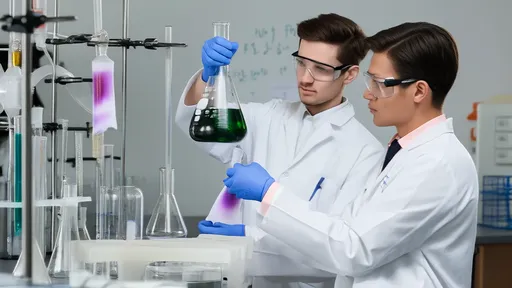
In the quiet corners of fashion chemistry laboratories, a revolution is brewing, one that is subtly transforming the very fabric of relationships—literally. The phenomenon of couple t-shirts, once a simple statement of unity, has evolved into a sophisticated canvas for chemical artistry. This is not merely about matching colors; it is about the deliberate, beautiful fusion of dyes at a molecular level, creating garments that are as unique as the bonds they represent. The process, a delicate dance of polymers, pigments, and bonding agents, turns ordinary apparel into wearable testaments to connection.
The journey begins with the selection of textiles, a critical foundation for any dyeing endeavor. Natural fibers like cotton and silk, with their hydrophilic and porous structures, offer an inviting landscape for dye molecules to penetrate and settle. Synthetic materials such as polyester present a different challenge; their hydrophobic nature demands specialized disperse dyes and high-temperature conditions to achieve successful coloration. The choice of fabric is the first chemical handshake between material and colorant, setting the stage for the intricate reactions to follow.
At the heart of this chromatic fusion lies the dye itself—a complex concoction of chromophores, the chemical groups responsible for color, and auxochromes, which enhance color intensity and affinity to the fiber. Reactive dyes, for instance, form covalent bonds with cellulose fibers in cotton, creating a permanent, wash-fast connection. Acid dyes, on the other hand, rely on ionic attractions to bond with protein-based fibers like wool or silk. For couple t-shirts, where longevity and vibrancy are paramount, the chemical stability of these bonds is non-negotiable. It is a marriage of color and cloth, sanctioned by atomic forces.
The application process is where theory meets texture. Techniques like dip-dyeing, where garments are partially immersed in dye baths, create gradients that symbolize the blending of two individuals into a shared identity. The precision of this method hinges on controlling variables such as dye concentration, temperature, and immersion time. A higher temperature accelerates molecular motion, encouraging dyes to diffuse deeply into the fibers, while prolonged immersion ensures saturation. For designs where two colors meet and merge—a visual metaphor for partnership—the chemistry must be meticulously calibrated to prevent muddying and ensure a crisp, intentional blend.
Fixation is the silent guardian of color permanence. After application, dyes must be locked into place, often through a process involving heat, steam, or chemical fixatives. Steam fixation, for example, opens up the fiber structure, allowing dyes to penetrate fully before sealing them in as the fabric cools. This step is crucial for couple t-shirts, which endure the trials of daily wear and frequent washing. Without proper fixation, the vibrant hues that symbolize unity would fade, much like a neglected relationship. Chemistry, in this sense, becomes a guardian of memory.
Yet, the innovation does not stop at traditional methods. Advances in nanotechnology have introduced self-cleaning and color-shifting fabrics, where photocatalytic nanoparticles break down dirt under light or thermochromic dyes change color with temperature. Imagine couple t-shirts that shift hue when embraced, a literal chemistry of affection made visible. Such technologies are pushing the boundaries of what textile dyeing can achieve, transforming garments into dynamic, interactive expressions of love.
However, this chemical romance is not without its ethical considerations. The textile industry is historically notorious for water pollution and toxic waste, with dyeing processes contributing significantly to environmental degradation. Sustainable practices are emerging, such as the use of natural dyes extracted from plants or microbes, which offer biodegradable alternatives. Waterless dyeing technologies, like supercritical fluid CO2 dyeing, are also gaining traction, reducing the ecological footprint of each vibrant shirt. For the conscious couple, the chemistry of their matching attire can now align with a chemistry of care for the planet.
In the end, the couple t-shirt is more than a fashion statement; it is a masterpiece of materials science and chemical engineering. Each garment tells a story of molecular alliances, of bonds formed and colors blended, mirroring the human connections they represent. As technology advances, so too will the depth and meaning woven into these fabrics, ensuring that the art of dyeing continues to evolve—not just as a craft, but as a celebration of togetherness, painted in the vivid hues of chemistry.

By /Aug 27, 2025

By /Aug 27, 2025
By /Aug 27, 2025
By /Aug 27, 2025

By /Aug 27, 2025
By /Aug 27, 2025
By /Aug 27, 2025

By /Aug 27, 2025

By /Aug 27, 2025

By /Aug 27, 2025

By /Aug 27, 2025

By /Aug 27, 2025

By /Aug 27, 2025

By /Aug 27, 2025

By /Aug 27, 2025

By /Aug 27, 2025

By /Aug 27, 2025
By /Aug 27, 2025

By /Aug 27, 2025

By /Aug 27, 2025
