Kite String Tension: A Mechanical Love Letter to the Aerial Dancer

Aug 27, 2025 By

As dawn breaks over the open field, a solitary figure begins the ancient dance with the wind. The kite ascends in trembling uncertainty, then catches a steady current and transforms into a living brushstroke against the morning sky. This delicate connection between earth and atmosphere, this tension on a single string, represents one of humanity's most poetic conversations with physics—a love letter written in kinetic energy and aerodynamic grace.

The relationship between kite and flyer begins with tension, that invisible thread of force that communicates every nuance of the wind's mood. When the line pulls taut, it speaks of rising thermals and favorable currents; when it goes slack, it whispers of atmospheric voids and shifting directions. Experienced flyers develop an intimate understanding of this language, their fingers reading the string like Braille, translating its vibrations into anticipatory adjustments. The dance becomes a dialogue where both partners lead and follow simultaneously.

Behind this aerial ballet lies a complex interplay of forces that would delight any physicist. The kite's shape, often taken for granted as mere decoration, represents generations of aerodynamic refinement. Traditional diamond designs create just enough drag to maintain stability while allowing lift to dominate. More sophisticated parafoils and delta configurations employ air pockets and curved surfaces to harness wind with breathtaking efficiency. Each design represents a different dialect in the language of flight.

The critical angle of attack—typically between 5 and 15 degrees—determines whether the kite will soar gracefully or stall dramatically. Too steep, and the wind breaks turbulently over the surface; too shallow, and it fails to generate sufficient lift. Master flyers develop an instinct for this balance, constantly adjusting their position and line tension to maintain that sweet spot where magic happens.

Wind itself becomes more than moving air to the serious kite enthusiast. It transforms into a textured, layered medium with distinct personalities at different altitudes. The flyer learns that surface winds often behave differently from those just fifty feet higher, that thermal activity increases in the afternoon, and that obstacles create wind shadows that can drop a kite from the sky without warning. This knowledge turns flying into a three-dimensional chess game with nature.

Modern materials have revolutionized the ancient art, but the fundamental physics remain unchanged. The transition from traditional paper and bamboo to ripstop nylon and carbon fiber has created kites that can withstand forces that would have destroyed their ancestors. Yet these technological advancements serve the same eternal purpose: to maintain that perfect tension between control and freedom, between human intention and natural force.

Competitive sport kite flying elevates this tension to an athletic discipline. Teams execute precision maneuvers with military exactness, their kites moving as synchronized extensions of their will. The tension on the lines becomes a critical feedback mechanism, communicating the need for split-second adjustments. In freestyle competitions, flyers push against the boundaries of physics, making their kites perform seemingly impossible rotations and dives that defy their inherent design limitations.

The mathematics of kite flying reveals hidden elegance in what appears to be simple recreation. The relationship between line length and control follows logarithmic rather than linear progressions. Wind speed relates to required tension through square functions. The bend of the kite's spar creates airfoil properties that Bernoulli would appreciate. These underlying principles unite in what flyers experience as "feel"—that indescribable connection through the humming line.

Cultural traditions around the world have long recognized the spiritual dimension of this mechanical poetry. In Bali, kite festivals feature traditional designs believed to carry messages to the gods. In Afghanistan, kite fighting becomes metaphorical warfare with lines coated in glass powder. Chinese mythology tells of kites carrying souls between realms. Across these traditions, the tension string serves as literal and figurative connection between earthly and divine.

Scientific applications have grown from this ancient pastime. Meteorologists use specialized kites to lift instruments into atmospheric layers inaccessible to ground equipment. Photographers employ kite aerial photography to capture perspectives otherwise unavailable. Engineers study kite dynamics to inform wind turbine design and airborne energy generation. The humble kite continues contributing to human knowledge while maintaining its playful spirit.

The psychological dimension of kite flying deserves equal attention to its physical aspects. There exists a meditative quality in maintaining that perfect tension, a mindfulness that requires complete presence while simultaneously freeing the mind from earthly concerns. The flyer becomes anchored to the ground yet liberated through this connection to the skies—a paradox that many describe as therapeutic.

As the sun sets and the flyer begins reeling in their companion from the darkening sky, there's a palpable sense of conversation ending. The line slackens as the kite descends, the tension easing like a deep exhale after meaningful dialogue. The dance concludes, but the memory of that connection remains—a testament to humanity's enduring desire to reach skyward while keeping our feet firmly on the ground.

This mechanical love letter between human and element, written in tension and turbulence, continues to captivate because it represents something fundamental about our relationship with nature. We seek not to conquer the wind, but to understand it well enough to dance with it. The kite string becomes both tether and freedom, limitation and possibility—a single thread that connects us to the vastness above while reminding us of our earthly origins.

Recommend Posts
Romance

Snowball Effect: The Accumulative Impact of Ice and Snow Crystals

By /Aug 27, 2025

In the hushed stillness of alpine landscapes, a silent architectural marvel unfolds with each passing storm. The phenomenon of snow accumulation, often poetically termed the snowball effect, represents one of nature's most fascinating examples of incremental growth creating monumental consequences. What begins as microscopic ice crystals suspended in clouds evolves through complex atmospheric processes into the sweeping white blankets that define winter landscapes across mountainous regions worldwide.
Romance

Decanting Wine: Oxidation Reactions and the Unfolding of Flavors"

By /Aug 27, 2025

There exists a quiet ritual in the world of fine wine, a practice both revered and debated with near-religious fervor. It is the act of decanting. To the uninitiated, it might seem like a purely theatrical performance, an elaborate pouring of wine from one vessel to another. But for the connoisseur, it is a crucial alchemical process, a deliberate unlocking of a wine's deepest secrets. At its heart, decanting is a dance with oxygen, a carefully managed oxidation reaction that can transform a tight, brooding liquid into a symphony of aromas and flavors. This is the story of that transformation, the science and the soul behind letting a wine breathe.
Romance

Instant Chemistry: The Eternal Moment in Instant Film Developer

By /Aug 27, 2025

In an age where digital photography dominates with its flawless precision and infinite reproducibility, there exists a tangible magic in the imperfect, singular beauty of instant film. The chemistry behind Polaroid photography represents one of the most fascinating intersections of art and science, where molecules and moments collide to create something truly ephemeral yet eternal. This is not merely a technical process; it is alchemy. It is the transformation of light into memory, sealed within a handheld artifact.
Romance

Ceramic Firing: The Irreproducible Romance of Kiln-Changed Glaze Colors"

By /Aug 27, 2025

In the hushed stillness of the kiln, where fire and earth engage in their ancient dance, something extraordinary occurs—a phenomenon so elusive that it has captivated artisans and collectors for centuries. This is the world of ceramic firing, where the alchemy of flame, mineral, and chance conspires to create what is known as yao bian, or kiln transformation glazes. These are not mere colors applied by human hand; they are the kiln’s own whispered secrets, rendered in breathtaking, unrepeatable beauty.
Romance

Love Letter Origami: The Expressive Art of Three-Dimensional Geometry"

By /Aug 27, 2025

In the quiet corners of papercraft, where mathematics meets emotion, a fascinating art form has been quietly evolving—origami love letters. This is not merely about folding paper into shapes; it is about encoding affection through geometric precision, turning flat sheets into dimensional declarations of love. The practice, which beautifully merges the rationality of spatial structures with the intimacy of personal messages, has captured the imaginations of artists, mathematicians, and romantics alike. It represents a unique intersection where art and science embrace, creating tangible expressions that are as intellectually stimulating as they are heartfelt.
Romance

Rainbow Formation: A Spectroscopic Love Poem of Water Droplet Refraction

By /Aug 27, 2025

When sunlight fractures across a rain-washed sky, it composes one of nature’s most beloved visual poems—the rainbow. More than a simple arc of color, it is a silent sonnet written in light, a spectral narrative born from the marriage of water and illumination. To understand the rainbow is to read between its lines, to trace the delicate interplay of refraction, reflection, and dispersion that gives it form. Each hue, from passionate red to tranquil violet, tells a chapter in this atmospheric epic, a story written not in ink, but in the very essence of light itself.
Romance

Fluorite Phosphorescence: The Dark Romance of Mineral Luminescence

By /Aug 27, 2025

In the silent depths of the earth, where sunlight never ventures and time seems suspended, a secret luminescence awaits its moment. This is the realm of fluorescent minerals, where ordinary-looking rocks conceal a breathtaking capacity to transform invisible energy into visible light—a phenomenon that has captivated scientists and poets alike. Among these luminous wonders, fluorite stands as one of the most enchanting, earning its poetic nickname: the "night-shining stone." Its ability to glow under ultraviolet light feels almost like a whispered secret from the earth itself, a dark romance between mineral and energy that plays out in shadows.
Romance

Tandem Bicycle: Gear Ratio and Cadence Synchronization

By /Aug 27, 2025

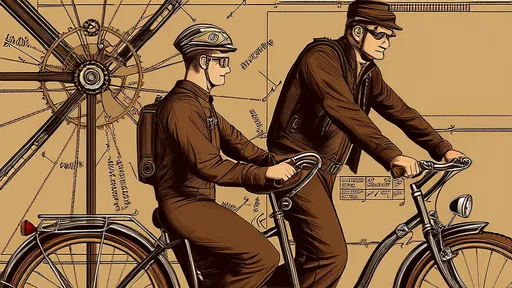
As the morning sun casts long shadows across the river path, a tandem bicycle glides by with near-silent precision. The riders move as one entity, their legs pumping in flawless harmony. To the casual observer, it appears to be a simple feat of coordination, but beneath this graceful motion lies a complex interplay of mechanical engineering and human synchronization—the delicate dance of gear ratios and cadence alignment that makes tandem cycling either a symphony of motion or a struggle for dominance.
Romance

Stargazing Tent: Sweet Focus of Astronomical Telescopes"

By /Aug 27, 2025

Under the vast velvet dome of the night sky, a new kind of communion with the cosmos is taking root. No longer confined to remote mountaintops or sterile observatories, amateur astronomy has found an intimate and unexpectedly poetic home: the stargazing tent. Paired with a trusty telescope, this simple shelter has transformed the act of celestial observation from a purely scientific endeavor into a profoundly personal, almost meditative ritual. It’s a trend blossoming in backyards, on quiet hillsides, and at dark-sky sites across the world, merging the primal comfort of a cocoon with the boundless wonder of the universe.
Romance

Perfume Molecules: Pheromones and the Chemistry of Love and Scent

By /Aug 27, 2025

In the intricate dance of human attraction, scent plays a role far more profound than we often acknowledge. Beyond the immediate pleasure of a fragrant bouquet or the comforting aroma of a familiar space, lies a complex chemical language that whispers directly to our primal instincts. This is the world of perfume molecules, where pheromones and aromatic compounds intertwine to create what can only be described as the chemistry of love. The very essence of this interaction challenges our understanding of romance, suggesting that our hearts may be guided by noses more than we realize.
Romance

Mechanics of Lock Bridges: Metal Fatigue and Load-bearing Commitment"

By /Aug 27, 2025

In the quiet world of civil engineering, few subjects carry as much weight—both literally and metaphorically—as the mechanics of suspension bridges. These soaring structures, with their elegant cables and towering pylons, represent a delicate balance between human ambition and the unyielding laws of physics. At the heart of their design and endurance lies a critical interplay between metal fatigue and the solemn promise of bearing immense loads over decades, even centuries.
Romance

Heartbeat Recording Studio: Memory Archives of Bioacoustics

By /Aug 27, 2025

In the hushed stillness of a recording studio, a new kind of archive is being built. It is not filled with the familiar sounds of music or spoken word, but with the subtle, rhythmic whispers of life itself. This is the world of Heartbeat Recording Studio, a pioneering initiative dedicated to the archival of biological acoustics—the sounds of living organisms, captured and preserved as a unique form of memory. The project, situated at the intersection of art, science, and technology, seeks to create a living library of heartbeats, breaths, and other internal symphonies, offering a profound new way to document and remember life in all its forms.
Romance

Crop Circles: The Geometry of Love Formed by Flattened Crops"

By /Aug 27, 2025

In the rolling hills of the English countryside, where golden wheat sways under summer skies, a mysterious phenomenon has captivated both skeptics and believers for decades. Known as crop circles, these intricate patterns etched into fields have sparked debates, inspired theories, and stirred the human imagination. Among them, one theme stands out for its emotional resonance: the recurring appearance of geometric formations interpreted as symbols of love. From hearts intertwined with mathematical precision to spirals evoking universal harmony, these designs blur the line between earthly art and otherworldly messages.
Romance

Specular Reflection: Tracing the Light Path in Eye-to-Eye Gaze

By /Aug 27, 2025

In the quiet intensity of a shared gaze, a silent conversation unfolds. The phenomenon of eye contact, a cornerstone of human interaction, has long fascinated psychologists, biologists, and artists alike. But beneath this familiar social ritual lies a breathtakingly complex physical and neurological ballet, a precise choreography of light, reflection, and perception. A journey into the optics of a mutual stare reveals a world where physics meets emotion, where beams of light become carriers of unspoken meaning.
Romance

Kite String Tension: A Mechanical Love Letter to the Aerial Dancer

By /Aug 27, 2025

As dawn breaks over the open field, a solitary figure begins the ancient dance with the wind. The kite ascends in trembling uncertainty, then catches a steady current and transforms into a living brushstroke against the morning sky. This delicate connection between earth and atmosphere, this tension on a single string, represents one of humanity's most poetic conversations with physics—a love letter written in kinetic energy and aerodynamic grace.
Romance

Time Capsule: Metal Anti-Corrosion Technology and Memory Preservation

By /Aug 27, 2025

In the quiet corners of archaeology labs and the sterile halls of data centers, an unusual convergence is taking place. The ancient, tangible craft of metal preservation is finding common cause with the modern, abstract science of digital memory storage. This intersection forms the core of a fascinating field we might call "temporal safekeeping"—the art and science of creating time capsules not just for objects, but for information itself, ensuring both can speak to the future.
Romance

Echoes from the Tree Hollow: Acoustic Enhancement Effects of Wooden Resonating Chambers"

By /Aug 27, 2025

In the quiet corners of acoustic research, a fascinating phenomenon has captured the attention of scientists and musicians alike: the sonic amplification properties of wooden resonance chambers. Often overlooked in favor of their metallic or synthetic counterparts, these organic cavities are demonstrating extraordinary capabilities in sound enhancement that challenge conventional acoustic engineering principles.
Romance

Couple Shirt Dyeing: Chemistry of Color Blending in Textiles"

By /Aug 27, 2025

In the quiet corners of fashion chemistry laboratories, a revolution is brewing, one that is subtly transforming the very fabric of relationships—literally. The phenomenon of couple t-shirts, once a simple statement of unity, has evolved into a sophisticated canvas for chemical artistry. This is not merely about matching colors; it is about the deliberate, beautiful fusion of dyes at a molecular level, creating garments that are as unique as the bonds they represent. The process, a delicate dance of polymers, pigments, and bonding agents, turns ordinary apparel into wearable testaments to connection.
Romance

Shell Seashell Art: The Acoustic Resonance Principle of Spiral Structures"

By /Aug 27, 2025

In the quiet coastal laboratories of marine bioacoustics, a groundbreaking discovery has emerged that challenges our fundamental understanding of how mollusks perceive their underwater world. The "Shell Listening Technique: Acoustic Resonance Principles of Spiral Structures" represents not merely an academic curiosity but a paradigm shift in marine sensory biology, revealing how the very architecture of shells enables sophisticated sound perception previously attributed only to complex biological hearing organs.
Romance

Chemistry of Candlelight Dinner: Flame Color Temperature and Atmosphere Creation"

By /Aug 27, 2025

There is an alchemy to the perfect candlelit dinner that transcends mere decoration or illumination. It is an intricate dance of physics, chemistry, and human perception, all conspiring to create an atmosphere of warmth, intimacy, and romance. While we often focus on the menu, the music, or the company, the very quality of the light we dine by plays a profoundly underappreciated role in setting the stage for the evening. The flicker of a flame does more than just push back the darkness; it paints the room with an emotional palette, and the master key to understanding this phenomenon lies in a concept known as color temperature.