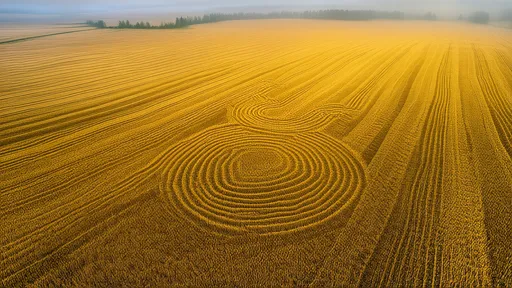
In the rolling hills of the English countryside, where golden wheat sways under summer skies, a mysterious phenomenon has captivated both skeptics and believers for decades. Known as crop circles, these intricate patterns etched into fields have sparked debates, inspired theories, and stirred the human imagination. Among them, one theme stands out for its emotional resonance: the recurring appearance of geometric formations interpreted as symbols of love. From hearts intertwined with mathematical precision to spirals evoking universal harmony, these designs blur the line between earthly art and otherworldly messages.
The history of crop circles dates back centuries, with early accounts often dismissed as folklore or hoaxes. However, the modern era of these formations began in the 1970s and 1980s, when complex patterns started appearing overnight in southern England. Initially simple circles, they evolved into elaborate geometries—mandalas, fractals, and even representations of mathematical constants like pi. It was during this period that formations explicitly symbolizing love emerged, often featuring heart shapes, pairs of interconnected rings, or sequences that evoked unity and connection. Farmers would wake to find their fields transformed into canvases of awe-inspiring beauty, sparking a global fascination.
What makes these love-themed crop circles particularly intriguing is their geometric sophistication. Researchers have documented formations where hearts are perfectly proportioned using sacred geometry principles, such as the golden ratio, which is often associated with beauty and harmony in nature. In one notable case in Wiltshire in 2001, a formation appeared depicting two overlapping hearts surrounded by a circle of smaller spheres, reminiscent of atomic or celestial models. The precision of the shapes, with stalks bent but not broken, suggested a level of craftsmanship that defied simple human explanation—at least for those who lean toward paranormal interpretations.
Skeptics, of course, have their own explanations. The most widely accepted theory attributes crop circles to human artists using simple tools like ropes and boards to flatten crops in planned designs. Teams of circlemakers have even come forward to demonstrate their techniques, showing how they create complex patterns under cover of darkness. For love-themed formations, some argue that they are intentional acts of artistic expression or even romantic gestures, crafted by individuals or groups seeking to leave a temporary mark of beauty. Yet, even among skeptics, the scale and precision of some designs raise questions about how such elaborate works are achieved so quickly and silently.
Beyond the debate over origins, the cultural impact of these love-themed formations is profound. They have inspired art, music, and literature, becoming symbols of hope and connection in a fragmented world. In communities near hotspot areas like Stonehenge or Avebury, crop circles have become tourist attractions, drawing visitors who seek inspiration or spiritual solace. Some couples have even chosen to marry near these formations, seeing them as blessings or signs of universal love. The imagery has permeated popular culture, appearing in films, albums, and fashion, often as metaphors for mystery and emotion intertwined.
Scientific studies have added layers to the mystery. Analyses of affected crops have shown anomalies such as elongated nodes in plant stems or changes in soil composition, which some researchers cite as evidence of unknown energies at play. For love-themed circles, these studies are often framed in the context of bioenergy or consciousness, with hypotheses suggesting that human emotion or intent might influence the formations. While mainstream science remains cautious, the data continue to fuel speculation and further investigation.
Ultimately, whether viewed as hoaxes, art, or messages from beyond, crop circles symbolizing love serve a deeper human need: the desire to find meaning and connection in the unknown. They remind us that geometry is not just cold mathematics but a language of patterns that resonate with our emotions—from the spirals of galaxies to the curves of a heart. As long as these formations appear, they will continue to inspire wonder, debate, and perhaps, a little more love in the world.
In the end, the truth behind crop circles may remain elusive, but their impact is undeniable. They challenge us to look beyond the obvious, to question our perceptions, and to embrace the possibility that mystery itself is a form of beauty. And in the case of those formations that speak of love, they offer a gentle reminder that even in the most unexpected places, symbols of connection can flourish—etched not just in crops, but in the human heart.

By /Aug 27, 2025

By /Aug 27, 2025

By /Aug 27, 2025
By /Aug 27, 2025

By /Aug 27, 2025
By /Aug 27, 2025
By /Aug 27, 2025
By /Aug 27, 2025
By /Aug 27, 2025
By /Aug 27, 2025
By /Aug 27, 2025

By /Aug 27, 2025
By /Aug 27, 2025
By /Aug 27, 2025

By /Aug 27, 2025

By /Aug 27, 2025

By /Aug 27, 2025

By /Aug 27, 2025

By /Aug 27, 2025

By /Aug 27, 2025
