In the hushed stillness of alpine landscapes, a silent architectural marvel unfolds with each passing storm. The phenomenon of snow accumulation, often poetically termed the snowball effect, represents one of nature's most fascinating examples of incremental growth creating monumental consequences. What begins as microscopic ice crystals suspended in clouds evolves through complex atmospheric processes into the sweeping white blankets that define winter landscapes across mountainous regions worldwide.
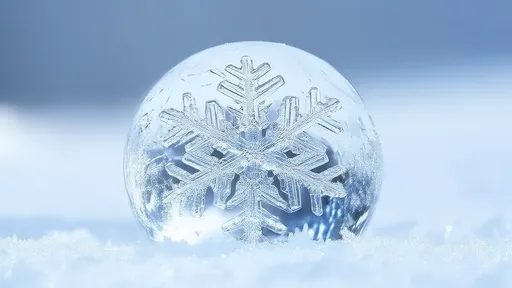
The journey commences when water vapor freezes onto microscopic particles in the atmosphere, creating the initial ice crystals that will eventually become snowflakes. These nascent formations develop intricate hexagonal patterns as they descend through varying temperature and humidity layers, their unique structures determined by precise atmospheric conditions encountered during their fall. No two flakes follow identical paths through the atmosphere, resulting in the infinite variety of crystalline structures that have captivated scientists and poets alike for centuries.
Upon reaching the earth's surface, these individual crystals begin their transformative work. The initial deposition creates a fragile latticework of ice and air, with the structure's stability depending heavily on temperature, wind conditions, and the crystal forms themselves. In cold, still conditions with low humidity, the snowpack develops as a light, fluffy mass containing up to 95% air. These conditions create what ski enthusiasts celebrate as champagne powder—a seemingly weightless substance that nonetheless accumulates into formidable depths.
The true magic of accumulation reveals itself through the process of metamorphism. Freshly fallen snow immediately begins transforming through three primary mechanisms: destructive metamorphism where sharp points sublimate and redistribute, constructive metamorphism creating depth hoar crystals, and melt metamorphism when temperatures approach freezing. These processes continuously reshape the snowpack's internal architecture, creating layers with dramatically different mechanical properties that ultimately determine slope stability.
Wind plays a crucial role in redistribution, often creating dramatic variations in snow depth across relatively small areas. As wind transports snow across the landscape, it breaks crystals into smaller fragments that become densely packed upon deposition. These wind slabs develop cohesive strength but often form over weaker layers, creating the conditions for slab avalanches when the stress exceeds the strength of the weak layer beneath.
The weight of accumulating snow creates increasing pressure on lower layers, driving the sintering process where ice grains bond together through vapor transfer. This natural cementing process strengthens the snowpack over time, allowing it to support increasing loads. However, this process occurs unevenly throughout the snowpack, creating variations in density and strength that influence everything from avalanche formation to water retention capabilities.
Perhaps most remarkably, the insulating properties of snow create self-perpetuating accumulation conditions. As depth increases, the ground becomes increasingly insulated from atmospheric temperatures, maintaining colder conditions that preserve the base layers even when surface temperatures fluctuate above freezing. This thermal regulation creates preservation conditions that allow snowpack to persist through temporary warming events, essentially creating its own refrigeration system.
The implications of snow accumulation extend far beyond winter recreation. Mountain snowpack serves as natural reservoirs, storing winter precipitation and releasing it gradually during spring and summer melt periods. This delayed runoff provides critical water supplies for agriculture, ecosystems, and human consumption across vast regions. In many western watersheds, snowpack contributes 70-80% of annual water supplies, making accurate accumulation measurements vital for water resource management.
Scientists employ increasingly sophisticated methods to measure and analyze snow accumulation. Traditional snow courses and snow pillows now complement airborne LiDAR surveys and satellite-based radar measurements that can penetrate cloud cover. These technological advances provide unprecedented detail about snow water equivalent—the critical metric that translates snow depth into actual water volume.
Climate change introduces new complexities to accumulation patterns. Warmer temperatures elevate snow levels, reduce snow season length, and increase the percentage of precipitation falling as rain rather than snow. These shifts alter accumulation timing, density, and distribution, creating cascading effects on water availability, ecosystem function, and hazard conditions. The delicate balance of temperature and precipitation that determines accumulation patterns represents one of the most climate-sensitive processes in nature.
The study of snow accumulation intersects numerous scientific disciplines from hydrology and climatology to material science and civil engineering. Researchers investigate everything from the microscopic bonding forces between ice crystals to the continental-scale patterns of snow distribution. This interdisciplinary approach has yielded improved avalanche forecasting, better water supply predictions, and enhanced understanding of how winter processes shape mountain environments.
For backcountry travelers, understanding accumulation patterns becomes a matter of safety. Reading the snowpack involves interpreting how successive storms, wind events, and temperature fluctuations have created a layered structure with varying strengths and weaknesses. This knowledge allows skilled practitioners to identify weak layers and make informed decisions about terrain selection and travel timing.
The cultural significance of snow accumulation permeates human history. Indigenous communities developed sophisticated knowledge systems for predicting snow conditions and understanding their implications for hunting, travel, and settlement patterns. This traditional knowledge, combined with modern scientific understanding, creates a more complete picture of how snow accumulates and functions within mountain ecosystems.
As research continues, scientists are discovering previously unappreciated aspects of snow accumulation. The role of black carbon and dust in accelerating melt, the impact of forest canopy on interception and redistribution, and the complex feedback loops between snow cover and climate patterns represent active areas of investigation. Each discovery reveals additional layers of complexity in this seemingly simple process of frozen precipitation building upon itself.
Engineering applications continue to evolve based on improved understanding of accumulation mechanics. Building designs in snow country incorporate load calculations based on regional snow data, while transportation departments develop increasingly sophisticated models for predicting road clearance requirements. The fundamental physics of snow accumulation informs everything from roof engineering to winter tire design.
The metaphorical power of the snowball effect finds its perfect physical manifestation in mountain snowpack. Small, incremental additions create massive accumulations with profound environmental consequences. This process demonstrates how seemingly insignificant actions—in this case, individual snowflakes falling—can combine to create forces that shape landscapes, influence climate, and sustain life. The silent, steady accumulation of winter's precipitation remains one of nature's most powerful examples of small things creating great effects.
Looking toward the future, the monitoring and understanding of snow accumulation patterns will only grow in importance as climate patterns shift and water resource management becomes increasingly critical. The delicate dance of temperature, precipitation, and wind that creates mountain snowpack represents a natural system of breathtaking complexity and vital importance—a system where the accumulation of countless tiny crystals literally moves mountains.
By /Aug 27, 2025

By /Aug 27, 2025

By /Aug 27, 2025

By /Aug 27, 2025

By /Aug 27, 2025

By /Aug 27, 2025
By /Aug 27, 2025
By /Aug 27, 2025
By /Aug 27, 2025

By /Aug 27, 2025
By /Aug 27, 2025

By /Aug 27, 2025
By /Aug 27, 2025

By /Aug 27, 2025

By /Aug 27, 2025
By /Aug 27, 2025

By /Aug 27, 2025

By /Aug 27, 2025

By /Aug 27, 2025

By /Aug 27, 2025
