In the quiet intensity of a shared gaze, a silent conversation unfolds. The phenomenon of eye contact, a cornerstone of human interaction, has long fascinated psychologists, biologists, and artists alike. But beneath this familiar social ritual lies a breathtakingly complex physical and neurological ballet, a precise choreography of light, reflection, and perception. A journey into the optics of a mutual stare reveals a world where physics meets emotion, where beams of light become carriers of unspoken meaning.
The journey of a single photon in this exchange is a marvel of precision. It begins its life, emitted or reflected from a light source, traveling until it strikes the face of one individual. From there, a fraction of those photons—those on a perfect trajectory—hit the cornea of the other person. This transparent outer layer acts as the first powerful lens, bending the incoming light waves inward. The light then passes through the aqueous humor and the pupil, the dark aperture whose size unconsciously modulates with interest, attraction, or threat, controlling the volume of light admitted into the eye's inner sanctum.
The photons’ most significant manipulation comes from the crystalline lens. This flexible, living structure fine-tunes their path, a process called accommodation, to ensure the incoming image is sharply focused. The light is then funneled through the vitreous humor, a clear gel, before its final destination: the retina. Here, at the back of the eye, the real magic of transduction occurs. Millions of specialized photoreceptor cells—rods for low-light vision and motion, and cones for color and fine detail—absorb the photon’s energy, triggering a cascade of electrochemical signals.
But this is only half the story. For a mutual gaze to be established, this process must occur simultaneously in two individuals, creating a reciprocal loop of observation. You are not merely seeing someone; you are seeing them see you. The photons that carry your image are traveling to them, while the photons carrying their image are traveling to you. This creates a closed optical circuit, a feedback loop of immense social and psychological significance. It is a bidirectional stream of visual information where both parties are simultaneously the observer and the observed.
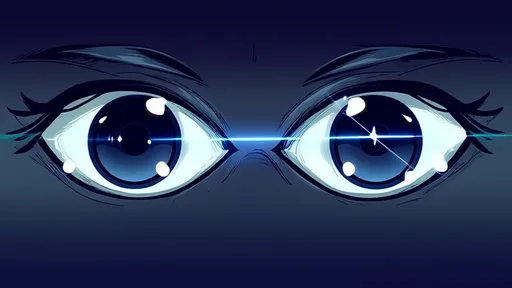
Central to the power of this exchanged look is the role of the mirror-like surface at the very back of the eye: the fovea centralis. This small pit, packed densely with cone cells, is responsible for our sharp central vision. When we make eye contact, we instinctively align our eyes so that the image of the other person's pupil falls directly onto our own fovea. This ensures we are seeing the greatest detail possible from that part of their face. Crucially, within the darkness of their pupil, we see a specular reflection—a tiny, bright glint of light known as the corneal reflection or catchlight. This glint is a key anchor point for our visual system.
Our brains are exquisitely tuned to locate the human gaze. A specialized network of neurons, sometimes informally called "gaze detection circuits," devotes significant processing power to analyzing the eyes of others. These neurons quickly calculate the relative position of the dark iris within the white sclera and, most importantly, the location of the corneal reflection. It is this calculation that allows us to instantly discern whether another's gaze is meeting ours, looking past us, or directed at an object nearby. The brain performs these complex geometric calculations subconsciously and near-instantaneously, informing us of the other’s focus of attention.
The psychological impact of this locked optical loop is profound. Meeting another's gaze triggers a surge of neurochemical activity. It can stimulate the release of oxytocin, the "bonding hormone," fostering feelings of trust and connection. Conversely, a prolonged stare from a stranger can trigger the amygdala, the brain's threat detection center, priming the body for a fight-or-flight response. The eyes are a direct conduit to our emotional state; pupil dilation can indicate arousal or interest, while constriction can suggest dislike or aggression. In a mutual gaze, we are unconsciously reading and transmitting a continuous stream of biometric data.
This complex dance is uniquely human. While many animals use gaze for threat or predation, the sustained, mutual eye contact common in human interaction is a rarity in the animal kingdom. The high contrast between our white sclera and colored iris—a trait far more pronounced in humans than in other primates—is believed to have evolved specifically to enhance gaze signaling. It makes the direction of our eyes incredibly easy to follow, enabling sophisticated non-verbal communication and cooperative social structures that underpin human civilization.
Modern technology is now learning to decode and even replicate this intimate exchange. Computer vision algorithms are trained to detect faces and track eye movement by identifying the same ocular landmarks our own brains use—the pupil, the iris boundaries, and the corneal glint. This enables everything from sophisticated UX research to assistive technologies for people with disabilities. However, creating a truly realistic mutual gaze with an artificial entity, like an avatar or a robot, remains a monumental challenge. The uncanny valley often manifests here, as we are hypersensitive to even the most minor lag or miscalculation in the simulated gaze, instantly detecting its artificiality.
Ultimately, the simple act of looking into another's eyes is anything but simple. It is a high-speed, physically precise, and neurologically rich interaction. It is a meeting of two conscious beings, confirmed through a reciprocal pathway of reflected light. It is a silent agreement to be seen and to see, a temporary merging of subjective experiences. In that mirrored loop of perception, we find a fundamental affirmation of a shared reality and a powerful, primal foundation for human connection.

By /Aug 27, 2025

By /Aug 27, 2025
By /Aug 27, 2025

By /Aug 27, 2025
By /Aug 27, 2025

By /Aug 27, 2025
By /Aug 27, 2025
By /Aug 27, 2025

By /Aug 27, 2025

By /Aug 27, 2025
By /Aug 27, 2025

By /Aug 27, 2025

By /Aug 27, 2025
By /Aug 27, 2025

By /Aug 27, 2025
By /Aug 27, 2025
By /Aug 27, 2025

By /Aug 27, 2025

By /Aug 27, 2025

By /Aug 27, 2025
