When sunlight fractures across a rain-washed sky, it composes one of nature’s most beloved visual poems—the rainbow. More than a simple arc of color, it is a silent sonnet written in light, a spectral narrative born from the marriage of water and illumination. To understand the rainbow is to read between its lines, to trace the delicate interplay of refraction, reflection, and dispersion that gives it form. Each hue, from passionate red to tranquil violet, tells a chapter in this atmospheric epic, a story written not in ink, but in the very essence of light itself.
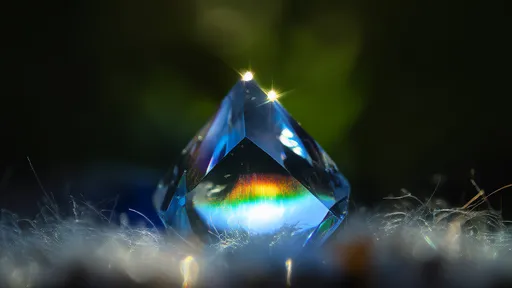
At its heart, the phenomenon begins with a droplet of rain—a minuscule,近乎 spherical lens suspended in the air. As sunlight enters this tiny prism, it slows and bends, a process known as refraction. But this is only the opening stanza. Within the droplet, the light strikes the inner surface and reflects, turning back toward the world it came from. And as it exits, it refracts once more, spreading out into the vibrant spectrum we recognize as the colors of the rainbow. This is not a mere scattering; it is a careful unraveling, a gentle teasing apart of wavelengths each traveling at their own pace and angle.
What emerges is a canvas of color, each band distinct yet blending seamlessly into the next. The red light, with its longer wavelength, bends the least, claiming the outer edge of the arc. Violet, with its short, energetic waves, curves the most, tracing the inner rim. Between them, orange, yellow, green, blue, and indigo weave a gradient so smooth it feels almost intentional—as though the sky itself is an artist carefully mixing hues on a celestial palette. This isn’t chaos; it’s ordered beauty, a demonstration of physical laws rendered with the grace of poetry.
Yet for all its scientific explanation, the rainbow retains its mystery, its emotional resonance. It appears when sun and storm meet, a symbol of hope etched against the retreating gray. It has been a bridge in mythology, a promise in scripture, and a muse for poets across centuries. There is something deeply human in our response to it—a longing, perhaps, for the reconciliation of opposites: storm and sun, science and spirit, the measurable and the magical.
And sometimes, if conditions align, the sky offers a second arc—a fainter, reversed twin to the first. This secondary rainbow arises from light reflecting twice within the raindrop, inverting the spectrum so that red lies within and violet without. It is a quieter verse in the same atmospheric poem, a reminder that nature often speaks in layers, in echoes. Between the primary and secondary bows, the sky darkens—a region known as Alexander’s band—where light has fled, leaving a space for shadow between the ribbons of color.
Even the shape of the rainbow is a kind of elegant deception. We see it as an arc, but in truth, it is a full circle—a fact often hidden by the horizon. From the right vantage, such as an airplane window, one can sometimes glimpse this complete halo of light, a perfect, unbroken spectrum orbiting the observer. It is a reminder that what we perceive is always a fragment of a larger, more perfect whole.
So the next time you see a rainbow gracing the sky, pause. You are not just seeing refracted light. You are witnessing a love letter between sun and storm, a spectral sonnet composed in droplets of rain. It is art written in the language of physics, a moment where the universe becomes both scientist and poet—and we, fortunate enough to glance upward, are its audience.

By /Aug 27, 2025

By /Aug 27, 2025

By /Aug 27, 2025

By /Aug 27, 2025

By /Aug 27, 2025
By /Aug 27, 2025

By /Aug 27, 2025

By /Aug 27, 2025

By /Aug 27, 2025

By /Aug 27, 2025
By /Aug 27, 2025

By /Aug 27, 2025
By /Aug 27, 2025
By /Aug 27, 2025

By /Aug 27, 2025

By /Aug 27, 2025

By /Aug 27, 2025

By /Aug 27, 2025
By /Aug 27, 2025

By /Aug 27, 2025
